
Medical Disclaimer: I’m a nutritionist, not a doctor or dermatologist, and everything below is for general educational purposes. It’s built on peer reviewed research and guidance from recognised medical bodies, but it can’t replace advice tailored to you specifically. If your acne is painful, cystic, scarring, or genuinely getting you down day to day, please talk to your GP or a dermatologist rather than leaning on diet alone to fix it.
I spent a long time assuming my skin would sort itself out once my PCOS was “under control.” It didn’t work that way for me, and going by the messages I get every week, it doesn’t work that way for a lot of women either.
You can be doing everything that’s supposedly right, blood sugar steady, weight heading in the right direction, cycles finally showing up on time, and still wake up to the same jawline breakout that has nothing to do with what you ate yesterday.
That disconnect is really the heart of the PCOS acne keto diet connection, and it’s a lot less tidy than most articles make it sound.
Understanding the PCOS Acne Keto Diet Connection
If you’ve spent any time Googling this at midnight, you’ve probably noticed most articles either oversell keto as some kind of hormone reset button or ignore the diet angle completely. Neither is quite right.
The real connection sits in your insulin and your androgens, two things that talk to each other constantly whether you’re paying attention or not. When insulin resistance is part of your PCOS picture, your body tends to push out more testosterone than it should, and it also produces less of a protein called SHBG, whose job is normally to keep that testosterone locked up and harmless.
Less SHBG means more free testosterone floating around, and that extra testosterone goes straight to work on your oil glands, which is exactly the kind of environment acne loves.
Cutting carbohydrates, whether through full keto or something more moderate, can improve insulin sensitivity for a lot of women, and better insulin sensitivity can, in turn, take some of the pressure off that whole chain.
That’s the honest version of the PCOS acne keto diet connection. It’s a real biological pathway with decent research behind it, not a guarantee, and definitely not something that happens overnight.
Why PCOS Acne Behaves Differently Than Regular Breakouts
Ordinary acne usually responds fairly predictably to a decent skincare routine, sleep, and keeping stress in check. PCOS related acne often refuses to play by those same rules, mostly because it’s being driven from inside the endocrine system rather than from anything happening on the surface of your skin.
Hyperandrogenism, which just means elevated androgens such as testosterone, is one of the defining features of PCOS under the Rotterdam diagnostic criteria, and it’s a big part of why this kind of acne tends to cluster along the jawline, chin, and lower cheeks, and to show up in a cyclical pattern tied to your hormones rather than to whatever you ate the day before.
Research on women with PCOS puts acne prevalence somewhere between 40 and 70 percent of that population, at least double the rate seen in women who don’t have the condition.
This is also part of why PCOS acne can hang around even while you’re losing weight. Weight change and hormonal change don’t always move at the same pace, so it’s entirely possible to lose fat mass and still be carrying enough insulin resistance and excess androgen to keep the acne pathway switched on.
The Biological Pathway: Insulin, Androgens, and Your Skin
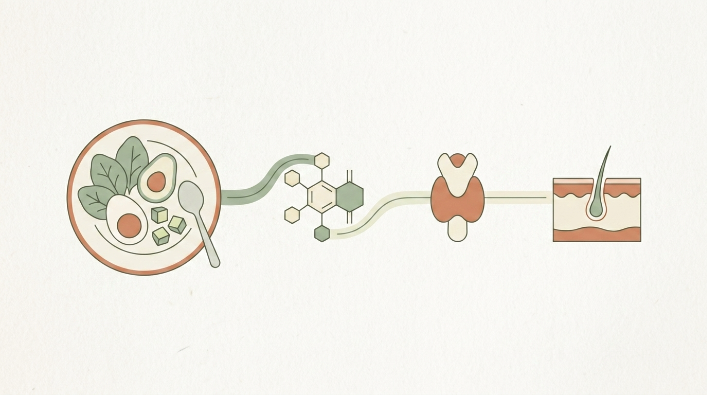
This is where I think most articles oversimplify things. It’s tempting to boil it down to “insulin causes acne,” but the actual chain of events has several links in it, and diet only really touches a couple of them.
In PCOS, insulin resistance can drive androgen excess by ramping up insulin and growth factor production, which then nudges the ovaries into making more testosterone.
That same process lowers sex hormone binding globulin, which raises free testosterone and sebum output, while insulin like growth factor 1 piles on top of that by further boosting oil production and clogging up hair follicles.
From there, the bacteria naturally living on skin have more to work with, and systemic inflammation appears to further contribute to visible breakouts.
What stood out to me while researching this is that a 305 woman study found younger age, higher DHEAS levels, and glucose metabolism disorders were all associated with acne presence and severity in PCOS. So the pathway is real and measurable. It is just not the only thing determining whether your skin clears.
What a Ketogenic or Lower Carbohydrate Diet Can Realistically Influence
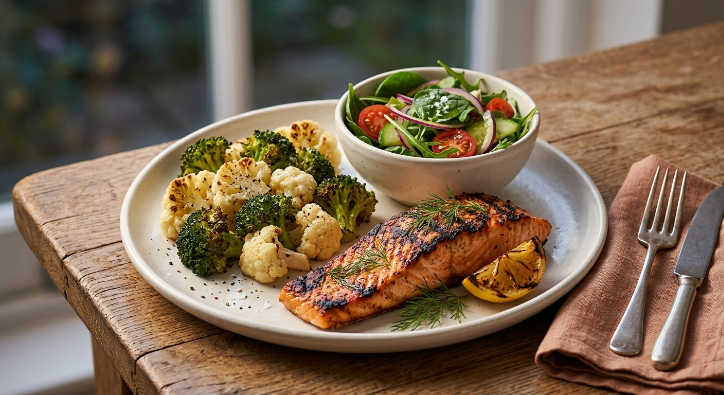
This is where keto might genuinely fit into the picture, though with real caveats. A 2025 systematic review and meta analysis of randomised controlled trials found that a carefully supervised very low carbohydrate ketogenic diet led to meaningful reductions in weight, visceral fat, insulin resistance, and androgen excess in women with PCOS.
Separately, an eight week trial comparing a moderate carbohydrate, plant forward diet against a stricter ketogenic diet in PCOS found both approaches improved fasting glucose, insulin, and reproductive hormones including LH, free testosterone, and DHEA sulfate.
Diet and acne research outside of PCOS points in a similar direction. A well known 12 week trial in young men found a low glycemic load diet led to a significantly greater reduction in acne lesion counts and insulin sensitivity than a typical higher glycemic diet.
A separate two week trial found a low glycemic index and load diet reduced IGF 1 among adults with moderate to severe acne, one of the biological drivers described above.
Put together, this is a plausible and partially evidenced mechanism: improving insulin sensitivity through carbohydrate reduction may, for some women, help lower the downstream signalling that feeds acne. That is different from saying it will clear your skin.
What Keto Cannot Guarantee, and Why
Keto is not an acne cure, and I would be doing you a disservice if I framed it that way. First, not all diet and acne research agrees.
Some trials looking at glycemic load and acne have produced mixed results, and researchers in this area have repeatedly noted that few randomised trials have actually examined the relationship, and the underlying process is not fully understood. That is a reason to hold the connection loosely, not to dismiss it.
Second, PCOS acne has multiple contributors beyond diet: genetics, the skin microbiome, stress hormones, sleep quality, certain skincare products, and for some women, dairy intake, which has been flagged as potentially proacnegenic in some populations independent of carbohydrate intake.
Third, strict keto is not the only, or necessarily the best, way to improve insulin sensitivity. A more moderate lower carbohydrate approach can achieve meaningful metabolic improvement with far less restriction, and tends to be easier to sustain long term, which matters more than any single “perfect” week of eating.
Evidence at a Glance

| Factor | What happens in PCOS | Possible relationship with acne | Where diet may fit | What the evidence actually tells us |
| Insulin resistance | Elevated insulin, reduced SHBG | Raises free testosterone, increases sebum | Lower carbohydrate intake may improve insulin sensitivity | Supported by multiple PCOS RCTs and meta analysis data |
| Androgens (testosterone, DHEAS) | Ovarian and adrenal overproduction | Directly stimulates sebaceous glands | Diet may lower androgens indirectly, not directly | Moderate, consistent mechanistic evidence |
| IGF 1 | Elevated with hyperinsulinemia | Amplifies sebum and follicular blockage | Low glycemic eating may reduce IGF 1 short term | Shown in small, short duration RCTs |
| Inflammation | Chronic low grade elevation | Worsens visible breakouts | Whole food, lower glycemic pattern may help | Plausible mechanism, limited direct trial data |
| Dairy and processed food | Not PCOS specific | Independently linked to acne in some studies | Reducing intake may help regardless of carb level | Mixed, population dependent evidence |
Expert Tips I Would Start With

Focus on insulin sensitivity first, not skin clearance, as the immediate goal. Blood glucose can shift within weeks, while skin, one of the slowest turning over tissues in the body, usually takes months to visibly reflect internal change.
Choose a lower carbohydrate pattern you can actually sustain, strict keto or something more moderate, since consistency matters more than hitting a specific ketone number. Our guide on insulin resistant PCOS versus lean PCOS explains why the right carbohydrate level genuinely differs by phenotype.
Watch your dairy intake for a few weeks if breakouts persist, since this is one of the more individually variable acne triggers, and prioritise protein and fibrous vegetables over packaged “keto” products. Our protein guide for women with PCOS covers practical targets.
Do not neglect sleep and stress, since cortisol interacts with the same pathways described above, and give it genuinely 3 to 6 months before judging whether diet changes are helping your skin.
Real Life Example
Imagine a woman in her late twenties with PCOS, elevated fasting insulin, irregular cycles, and persistent jawline acne that flares before her period.
She moves to a lower carbohydrate, higher protein way of eating, choosing moderate rather than strict ketosis after finding full keto too restrictive.
Within six weeks her energy stabilises and her cycles become slightly more regular. Her skin barely changes for the first two months, then gradually calms around month three, with fewer new cystic breakouts, though not complete clearance. She continues using a dermatologist recommended topical retinoid throughout.
This is a hypothetical scenario built from the research patterns above, not a real documented case. It illustrates a realistic, moderate outcome rather than a dramatic transformation, which is what the evidence actually supports for most women.
Common Mistakes I See Women Make

Assuming keto automatically treats acne the way it treats blood sugar, when the two run on different timelines and different variables.
Expecting visible skin change within the first few weeks, then giving up before the metabolic improvements have had time to translate downstream.
Focusing only on carbohydrates while ignoring overall diet quality, sleep, stress, and dermatological treatment, all of which contribute independently.
Treating every PCOS diagnosis as metabolically identical, when insulin resistant and lean PCOS phenotypes respond differently to carbohydrate restriction, something we cover in our piece on does your period come back on keto with PCOS.
Using extreme, unsustainable restriction, which can raise cortisol and work against the hormonal balance you are trying to achieve.
Believing social media before and after posts over the more modest, individually variable outcomes seen in clinical research.
Who Should Be Cautious With Strict Keto
Strict keto isn’t a fit for every woman with PCOS, and I say that as someone who genuinely likes the approach.
If you’ve got a history of disordered eating, you’re trying to conceive, you’re managing a thyroid condition, or you’re on insulin or another glucose lowering medication, talk to your GP, your endocrinologist, or a registered dietitian before you overhaul your diet.
There’s no version of this article that can account for your bloodwork or your medication list, and a five minute conversation with someone who can see your chart is worth more than anything written here.
Same goes if your skin is genuinely struggling. Severe, cystic, or scarring acne is not something a lower carb plate is going to sort out on its own.
Get to a dermatologist. Keep working on the diet piece too if you want, but don’t let “let’s see if food helps first” turn into months of waiting on something that needed proper treatment from the start.
The Practical Takeaway
Here’s what I actually want you to remember out of all of this. The PCOS acne keto diet connection is real, not made up, not wellness marketing dressed up as science.
Insulin resistance and androgens genuinely do talk to your skin, and for a good number of women, pulling carbs down can quiet that conversation a bit. But it’s one piece of a much bigger picture.
Acne has too many moving parts, genetics, stress, sleep, sometimes dairy, sometimes just bad luck, for any single diet to promise it away. Treat keto as a lever you can pull, not a switch you can flip.
Conclusion
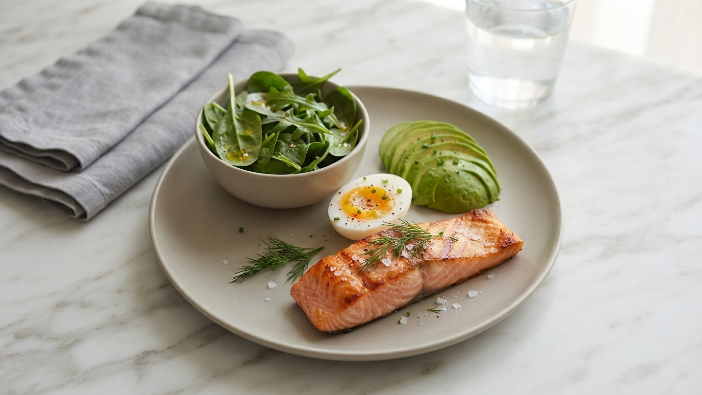
After spending weeks buried in this research, here’s what stuck with me. The PCOS acne keto diet connection is worth taking seriously, but it deserves better than the before and after story the internet keeps trying to sell you.
Insulin and androgens do shape what shows up on your skin, and cutting carbs can, for some of us, turn that volume down a notch.
It won’t rewrite your genetics. It won’t replace a dermatologist if you need one. And it definitely won’t move at the same speed as your blood sugar numbers.
So if you walk away with just one thing, make it this: give the process time, keep your expectations honest, and you’ll get further than anyone chasing a promise that diet culture invented, not the research.
FAQs PCOS Acne Keto Diet Connection
Can keto help PCOS acne?
For some women, yes, though indirectly. Better insulin sensitivity can mean less androgen and IGF 1 signalling reaching the skin. Nobody can promise it’ll clear you up.
What causes acne in women with PCOS?
Mostly androgens, testosterone in particular, doing more than they should. Insulin resistance tends to make that worse. Throw in inflammation, genetics, and whatever skincare you’re using, and you’ve got the full picture.
Does insulin resistance make PCOS acne worse?
It looks that way from the research. Women with higher fasting glucose and other insulin resistance markers tend to show more acne, and worse acne, than those without.
Can reducing carbohydrates improve hormonal acne?
There’s evidence pointing that direction, mostly from low glycemic diet trials that weren’t PCOS specific but still showed fewer acne lesions. It’s not a slam dunk across every study though.
How long might dietary changes take to affect PCOS acne?
Longer than you’d like, honestly. Blood sugar can shift in days. Skin usually takes two to six months before you’d notice much of a difference.
Is keto necessary for PCOS acne, or is a more moderate diet enough?
Not necessary. A more moderate lower carb approach hits the same insulin sensitivity target and tends to be a lot easier to live with.
Can PCOS acne improve without losing weight?
It’s possible. Insulin and androgen levels don’t move in perfect step with the scale, so skin can change even when weight hasn’t moved much.
When should I see a dermatologist for PCOS acne?
If it’s painful, cystic, leaving marks, or just not budging after a few months of reasonable changes, go see one. There are treatments a dermatologist can offer that no amount of dietary tinkering will match.