Medical Disclaimer: This article combines research review with practical, real-world guidance. It’s for educational purposes only and isn’t a substitute for advice from your GP, endocrinologist, or a registered dietitian — especially if you also manage a thyroid condition, a history of disordered eating, or you’re trying to conceive.
Two women can both be told “you have PCOS,” open the same keto app, follow the same macros, and end up in completely different places six weeks later. One feels sharper, drops weight steadily, and finally sees her cycle regulate.
The other feels wiped out, loses her period entirely, and somehow gains fat around her middle despite eating “clean.” Neither one is doing keto wrong. They’re doing two different diseases that happen to share the same name.
That’s the piece almost nobody explains clearly: keto diet insulin-resistant PCOS vs lean PCOS are not the same condition wearing different body sizes. They run on different hormonal engines, they respond to carbohydrate restriction in different ways, and in some cases, the exact diet that helps one type can genuinely work against the other.
If you’ve searched “keto diet insulin resistant PCOS vs lean PCOS” because something isn’t adding up for you, this guide is built to answer that — with the actual mechanisms, the research behind them, and where keto fits (and where it doesn’t) for each type.
Quick Answer: Keto Diet Insulin-Resistant PCOS vs Lean PCOS
Only got a minute? Here’s the gist.
About 65–75% of PCOS cases are the insulin-resistant type. Insulin stays high, day after day, and that’s what pushes the ovaries to pump out extra androgens and stalls ovulation. Cut the carbs and you’re going straight at that mechanism — which is basically why keto has the best research track record for this group specifically.
Lean PCOS is a different animal. Normal BMI, but insulin sensitivity can still be off in plenty of women who have it. The bigger drivers tend to be androgen excess and an HPA axis (your stress-hormone system) that overreacts easily — sometimes there’s an adrenal or inflammatory piece mixed in too.
Insulin’s not absent here, it’s just smaller and much less predictable than what you see in the insulin-resistant group. That’s why jumping into strict, low-calorie keto isn’t the obvious move for someone with lean PCOS. For some women it does the opposite of what they wanted — cortisol climbs, cycles get messier, and restrictive eating can tip into something worse. Most of the time, a softer approach works better: lower-glycemic, still nutrient-dense, borrowing a few keto habits without going all the way into ketosis.
So why does the same diet split two ways like this? Let’s get into it. (You will be curious about weight loss; how I lost weight read it: 7 Best Foods for PCOS Weight Loss: What I Ate to Lose 40kg (Real Results)
What Is PCOS, Really? (A Fast Primer Before the Comparison)
Diagnosis comes down to the Rotterdam criteria, and you only need two of three: ovulation that’s irregular or absent, some sign of excess androgens (you can see it, or it’s in your bloodwork), and ovaries with that classic polycystic look on ultrasound.
Here’s the thing people miss — weight isn’t on that list anywhere. Not one of the three criteria mentions BMI. Which is exactly why PCOS turns up in women of every size, not just women carrying extra weight.
Researchers generally describe four phenotypes under that umbrella, and they matter more than most PCOS content admits:
- Phenotype A — androgen excess + irregular ovulation + polycystic ovaries. The “classic” type, carrying the highest metabolic risk and the strongest insulin-resistance link.
- Phenotype B — androgen excess + irregular ovulation, without the ultrasound finding. Often more adrenal-driven.
- Phenotype C — androgen excess + polycystic ovaries, but ovulation is preserved.
- Phenotype D — irregular ovulation + polycystic ovaries, without measurable androgen excess. This is the phenotype most associated with “lean PCOS” presentations, though lean women can technically fall into any phenotype.
Insulin-resistant PCOS and lean PCOS aren’t official diagnostic categories in themselves — they’re practical, body-composition-based groupings clinicians and researchers use because they predict such different symptom pictures and treatment responses.
What Is Insulin-Resistant PCOS?

Picture the “typical” PCOS case and this is probably what comes to mind — higher BMI, weight that won’t budge from the midsection, blood sugar or insulin numbers already heading in the wrong direction. Somewhere around 70–80% of women with obesity and PCOS fall into this category, so it’s not a small subgroup — it’s the majority.
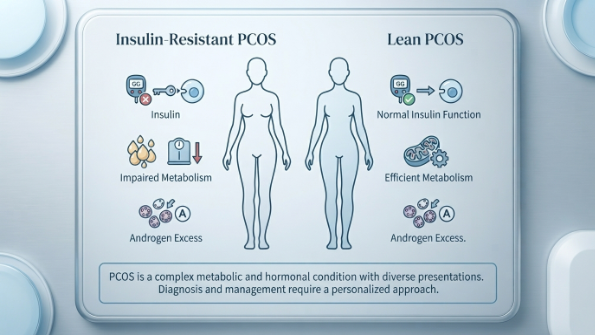
The mechanism is a feedback loop: chronically high insulin stimulates the ovarian theca cells to overproduce testosterone; high insulin also lowers sex-hormone-binding globulin (SHBG) — the protein that mops up excess testosterone in the bloodstream — which leaves more androgen “free” and biologically active.
More free androgen worsens acne, hirsutism, and hair thinning, while also disrupting the LH/FSH signaling needed for ovulation. Weight gain, especially visceral fat, further worsens insulin resistance, and the cycle reinforces itself.
My Note: This is the group almost every keto-for-PCOS article, meal plan, and testimonial online is actually describing. It’s why keto content for PCOS so often overpromises for readers who don’t fit this exact profile — the underlying research was mostly done on this population.
What Is Lean PCOS?
Lean PCOS describes women who meet Rotterdam criteria for PCOS but sit at a normal BMI (generally under 25 kg/m²) — sometimes markedly underweight, sometimes simply average-sized. For years, lean PCOS was treated almost as a footnote, on the assumption that “no weight problem” meant “no metabolic problem.” Recent research has firmly overturned that assumption.
A comparative cross-sectional study using detailed glucose tolerance testing found that lean women with PCOS were just as insulin-resistant as obese PCOS patients, and actually more hyperinsulinemic than obese controls, even though their insulin sensitivity was somewhat better overall.
The same research noted that measuring fasting insulin alone can miss insulin resistance in lean women with PCOS entirely — you need a full glucose tolerance test with multiple time points to catch it.
Adolescent data tells a similar story. A 2024 analysis presented at the Pediatric Endocrine Society meeting, using the long-running Project Viva cohort, found that teenage girls with lean PCOS had meaningfully higher insulin resistance and a worse adipokine profile than lean girls without PCOS — while girls with PCOS and higher BMI showed no such difference compared to their non-PCOS, higher-BMI peers.
In other words: PCOS itself carries metabolic risk in a lean body, even when it’s invisible on a routine blood panel or a bathroom scale.
That said, insulin resistance in lean PCOS is inconsistent across the research — estimates range roughly from 20–25% of lean PCOS women showing insulin resistance up to closer to half in some cohorts, compared with the large majority of women with obesity-associated PCOS. This is the core reason lean PCOS can’t simply borrow the insulin-resistant PCOS playbook and expect the same results.
Lean PCOS symptoms tend to be driven more heavily by androgen excess and HPA-axis (cortisol/stress hormone) sensitivity, which is also why lean PCOS is more often linked to visible hyperandrogenism — acne, hirsutism, scalp hair thinning — relative to metabolic symptoms like rapid weight gain.
Insulin-Resistant PCOS vs Lean PCOS: At a Glance
| Feature | Insulin-Resistant PCOS | Lean PCOS |
| Typical BMI | Overweight/obese (BMI ≥25) | Normal weight (BMI <25) |
| Insulin resistance prevalence | ~70–80% | ~20–50%, often under-detected |
| Primary driver | Chronic hyperinsulinemia → excess androgens | Androgen excess, HPA-axis/cortisol sensitivity, variable insulin component |
| Fasting insulin/glucose | Often abnormal on routine testing | Frequently normal — resistance hides in post-meal insulin spikes |
| Weight pattern | Central/visceral fat gain, harder to lose weight | Stable or low weight, sometimes difficulty gaining muscle |
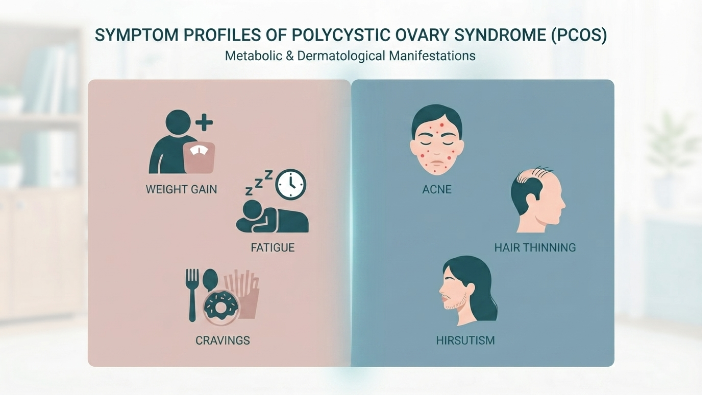
| Dominant symptoms | Weight gain, fatigue, sugar cravings, acanthosis nigricans | Acne, hirsutism, hair thinning, more pronounced cycle irregularity |
| Cardiometabolic risk | Elevated (type 2 diabetes, dyslipidemia) | Present but often underestimated; not zero |
| Best-studied keto response | Strongest, most consistent evidence base | Very limited direct evidence; extrapolated, not proven |
Symptom Comparison Table
| Symptom | More Common in Insulin-Resistant PCOS | More Common in Lean PCOS |
| Rapid or stubborn weight gain | ✔ | Rarely |
| Sugar/carb cravings, energy crashes | ✔ | Sometimes |
| Skin tags, acanthosis nigricans (dark, velvety skin patches) | ✔ | Rare |
| Acne (jawline/chin pattern) | Common | ✔ Often more pronounced |
| Hirsutism (excess facial/body hair) | Common | ✔ Often more pronounced |
| Scalp hair thinning | Common | ✔ Often more pronounced |
| Irregular or absent cycles | ✔ | ✔ (both types) |
| Fatigue after meals | ✔ | Less typical |
| Anxiety/mood sensitivity to stress | Present | ✔ Often more pronounced |
| Difficulty conceiving | ✔ | ✔ (both types) |
Hormonal and Lab Marker Differences
| Marker | Insulin-Resistant PCOS Pattern | Lean PCOS Pattern |
| Fasting insulin | Often elevated | Frequently normal |
| HOMA-IR | Often elevated | Can be normal or mildly elevated; a 2024 pediatric cohort found lean PCOS teens averaged 2.8 vs 2.1 in lean non-PCOS peers |
| 2-hour post-glucose insulin (OGTT) | Elevated | Can be elevated even when fasting insulin looks normal |
| SHBG | Often low | Can be normal or low |
| Free/total testosterone | Elevated | Often elevated, sometimes the dominant abnormality |
| DHEA-S | Variable | Frequently elevated — more adrenal-pattern androgen excess |
| LH/FSH ratio | Variable, often elevated | Frequently elevated, especially in Phenotype B/D |
| Adiponectin-leptin ratio | Lower (worse) | Also found to be lower than non-PCOS lean peers in recent adolescent data |
Why Keto Affects Each Type Differently
Ketogenic diets work primarily by removing the dietary trigger for insulin release. Less circulating glucose means less insulin secretion, which — in a body where hyperinsulinemia is the main problem — directly interrupts the cycle driving androgen excess and anovulation.
That’s the mechanism behind most of the positive keto-PCOS research.
But that mechanism assumes insulin is the dominant problem. In lean PCOS, where the driver is more often androgen excess through adrenal pathways, HPA-axis sensitivity, or inflammatory signaling, removing carbohydrates doesn’t address the root cause in the same way — and the other physiological effects of strict ketosis start to matter more:
- Caloric and carbohydrate restriction raises cortisol in many people, at least during the adaptation phase. In a phenotype already sensitive to HPA-axis dysregulation, that’s working against the goal, not toward it.
- Very low-carbohydrate, calorie-restrictive eating can suppress reproductive hormone signaling in people without much body fat to spare — this is the same broad mechanism behind hypothalamic amenorrhea, and lean women (with or without PCOS) have less physiological buffer against it.
- There is little to no lean-PCOS-specific keto research at all. A December 2025 systematic review and meta-analysis of ketogenic diets in PCOS explicitly noted that because most participants across the included studies had a BMI above 25 kg/m², the findings cannot be extrapolated to women with normal weight or lean PCOS. That’s not a minor caveat — it’s the researchers themselves saying the evidence doesn’t cover this group.
Benefits of Keto for Insulin-Resistant PCOS
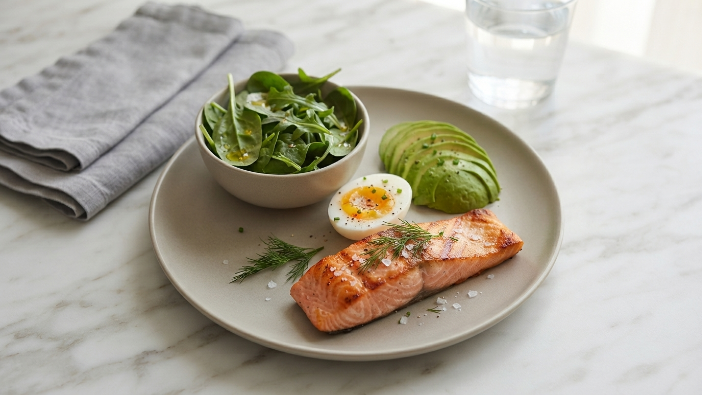
The research here is still developing, but what exists so far is genuinely promising.
Merra and colleagues ran a 12-week ketogenic Mediterranean-style diet study, published in the Journal of Translational Medicine, and found testosterone and luteinising hormone both dropped alongside real weight loss — progesterone and oestrogen improved too.
Then there’s the December 2025 systematic review and meta-analysis mentioned earlier. Looking specifically at women with PCOS and a BMI above 25, it found ketogenic diets led to bigger reductions in BMI, waist circumference, and body weight than other dietary approaches, plus lower triglycerides and total cholesterol.
The researchers’ bottom line: keto can improve body composition, metabolic markers, and some hormone outcomes in women with PCOS — especially those carrying excess weight — though they were careful to note the studies varied enough in quality that the results should be read with some caution.
Worth mentioning too is the very low-calorie ketogenic diet, or VLCKD — built around 500–800 kcal a day, 1–1.5g of protein per kg of ideal body weight, and under 50g of carbs. The Italian Society of Endocrinology has put out a formal consensus statement backing its use for obesity-related metabolic disease, PCOS-associated obesity included, but only under medical supervision.
My Recommendation: If you fit the insulin-resistant profile — higher BMI, fasting insulin or HOMA-IR that’s off, weight concentrated around your midsection — a properly built ketogenic diet is genuinely one of the better-supported options on the table right now. Just ease into it rather than diving in headfirst, keep an eye on electrolytes and protein, and get a GP or dietitian checking your labs as you go.
Potential Drawbacks of Keto for Lean PCOS
This is the section most keto content skips entirely, and it’s the one lean-PCOS readers most need.
- The evidence doesn’t support it the same way. As above, the strongest keto-PCOS research explicitly excludes or can’t be extrapolated to normal-weight women.
- Disordered eating risk. Women with PCOS as a group show a higher-than-average association with disordered eating patterns, and a nutrition practice that works with PCOS clients has specifically flagged this as a reason to be cautious about highly restrictive diets like keto in this population, given the risk of triggering restrictive or binge-restrict cycles.
- Cycle disruption risk. Because lean women have less metabolic “buffer,” aggressive calorie or carbohydrate restriction can push toward functional hypothalamic amenorrhea territory — the opposite of the improved-ovulation outcome you’re trying to achieve.
- Nutrient and fiber gaps. Very low-carbohydrate eating cuts out much of the fiber, polyphenol, and micronutrient load found in fruit, legumes, and whole grains — categories that matter for gut microbiome diversity, which emerging PCOS research increasingly links to inflammation and insulin sensitivity.
- It may simply be solving the wrong problem. If androgen excess and cortisol sensitivity — not insulin — are your primary drivers, strict ketosis doesn’t target your actual mechanism, and the restriction itself may add a stressor you don’t need.
Macronutrient Recommendations by PCOS Type
| Insulin-Resistant PCOS | Lean PCOS | |
| Carbohydrates | 20–50g net carbs/day (standard keto range), from low-glycemic, fibrous sources | 100–150g/day, low-glycemic focus rather than strict restriction |
| Protein | 1.2–1.6g per kg body weight; prioritize at each meal for satiety and androgen-lowering effects | 1.2–1.6g per kg body weight; same target, but total calories should not be restricted |
| Fat | Moderate-high, from olive oil, avocado, oily fish, nuts | Moderate, with more room for whole-food carbohydrate sources displacing some fat calories |
| Calories | Modest deficit if weight loss is a goal, monitored | Maintenance or only a very slight deficit — avoid aggressive restriction |
| Fiber | 25–35g/day within carb allowance where possible | 25–35g/day, easier to hit with a higher carbohydrate ceiling |
Sample Day of Eating: Two Approaches
Insulin-Resistant PCOS (Ketogenic Framework)
- Breakfast: Scrambled eggs with spinach and avocado, cooked in olive oil
- Lunch: Grilled salmon, mixed leafy greens, olive oil and lemon dressing
- Snack: Handful of macadamia nuts, a few slices of cucumber
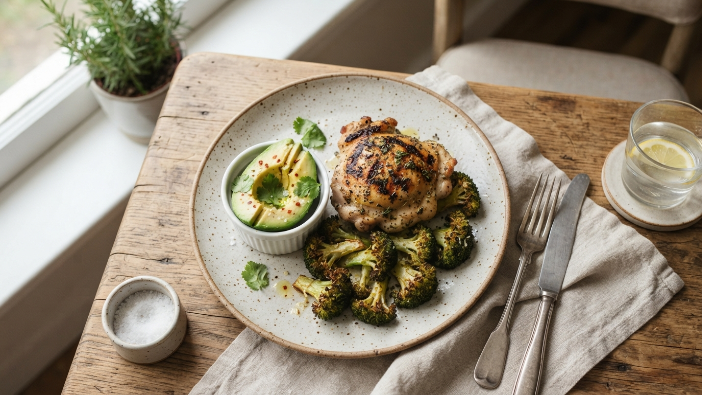
- Dinner: Chicken thighs, roasted courgette and broccoli, butter
Lean PCOS (Lower-Glycemic, Adequate-Calorie Framework)
- Breakfast: Greek yoghurt with berries, chia seeds, and a drizzle of honey
- Lunch: Quinoa bowl with grilled chicken, chickpeas, roasted vegetables, tahini dressing
- Snack: Apple with almond butter
- Dinner: Baked cod, sweet potato, steamed green beans, olive oil
Exercise Recommendations by Type (Keto Diet Insulin-Resistant PCOS vs Lean PCOS)

If you’ve got insulin-resistant PCOS, resistance training is your best friend — aim for 2–3 sessions a week. Building muscle helps because muscle tissue is more insulin-sensitive, so more of it working for you means better blood sugar control overall.
Pair that with moderate cardio and you’re in good shape. One thing to watch, though: fasted, high-intensity workouts. They can spike cortisol, and in a body that’s already dealing with insulin resistance, that’s not a trade you want to make too often.
Lean PCOS calls for a different balance. Resistance training still matters here — arguably more, since low body fat combined with low muscle mass isn’t actually a great metabolic place to be. But instead of leaning on intense cardio, walking and other low-intensity movement tend to serve this group better.
Frequent high-intensity or fasted sessions can wind up the HPA axis even further, and that’s already a sensitive system in lean PCOS, so there’s no need to add fuel to that fire.
Fertility Considerations
Both types can run into ovulatory dysfunction, but they get there differently — so the fix isn’t the same either. With insulin-resistant PCOS, working on insulin sensitivity (through diet, exercise, sometimes metformin) is usually the one change that moves the needle most for getting ovulation back on track.
SOGC — the Society of Obstetricians and Gynaecologists of Canada — has reviewed the research and backs insulin-sensitizing strategies, inositols included, as part of first-line care for women whose PCOS comes with metabolic issues.
Lean PCOS asks for a different starting point. Here, the focus usually shifts toward tackling androgen excess directly and reaching for insulin-sensitizing supplements like myo-inositol.
Current guidance actually spells this out: inositols are considered first-line for women with metabolic abnormalities and irregular cycles, while weight-loss-focused lifestyle changes are the first step specifically for women who are overweight or living with obesity.
If you’re lean and there’s no extra weight to lose, that second path just doesn’t apply to you — you need a plan built around what’s actually going on in your body.
If fertility is your goal on either path, strict, prolonged very-low-calorie ketogenic protocols are generally something to plan around a fertility specialist, not run independently — some VLCKD research in infertility contexts has specifically been studied as a pre-treatment weight-loss phase ahead of IVF in women with overweight or obesity, not as an ongoing fertility diet in itself.
Weight Management: Two Very Different Goals
For insulin-resistant PCOS, weight loss is often a legitimate, evidence-supported goal, and ketogenic approaches have real data behind them for this group specifically.
For lean PCOS, “weight management” usually isn’t about losing weight at all — it’s about body composition (building or preserving lean muscle), stabilizing blood sugar swings, and avoiding the kind of restriction that risks tipping a lean frame into an energy deficit large enough to disrupt hormone signaling.
Chasing weight loss as a goal here, when there’s no clinical indication for it, tends to create more problems than it solves.
Common Mistakes
- Applying insulin-resistant PCOS advice to lean PCOS wholesale. The most common mistake by far, and the reason this article exists.
- Relying on a single fasting insulin test to rule out insulin resistance in a lean body. As covered above, it frequently misses it.
- Under-eating on keto because “PCOS = need to lose weight.” Not automatically true, and actively harmful for underweight or normal-weight women with a suppressed cycle.
- Ignoring cortisol and sleep while focused entirely on carbs. Relevant for both types, but especially undermining in lean PCOS.
- Starting strict keto without baseline bloodwork. Fasting insulin, HOMA-IR, thyroid panel, and a full hormone panel give you a starting point to actually judge whether the approach is working.
Who Should Avoid Strict Keto
- Anyone with a current or past history of disordered eating
- Anyone with irregular or absent cycles who is already at a normal or low BMI
- Anyone actively trying to conceive without medical supervision of the diet plan
- Anyone with a personal or family history of gallstones, pancreatitis, or certain lipid disorders, without medical clearance
- Anyone on insulin or sulfonylurea medications, without dose adjustment supervision (risk of hypoglycemia)
When to Seek Medical Advice
A few signs mean it’s time to loop in a GP, endocrinologist, or registered dietitian rather than trying to figure it out on your own.
Your period stops, or shows up far less often, after you start eating low-carb or keto. You’re dropping weight fast without meaning to.
Your hair loss suddenly picks up pace. You still feel wiped out weeks into keto instead of adapting like you’d expect. Or — maybe simplest of all — you’re just not sure which PCOS type actually describes you.
That last one’s worth sorting out properly: an OGTT with insulin, a full androgen panel, and a thyroid check will tell you far more than trying to read your own symptoms ever could.
Expert Tips: Choosing the Right Strategy for Keto Diet Insulin-Resistant PCOS vs Lean PCOS

Registered dietitian guidance — OnPoint Nutrition
OnPoint’s dietitian team has published guidance cautioning against strict keto for PCOS management broadly, citing its highly restrictive nature, the difficulty most people have sustaining true ketosis long-term, and a documented association between PCOS and higher rates of disordered eating.
Why it matters: This is the counterweight every keto-for-PCOS article should include. It’s a strong argument for why lean PCOS in particular — where the insulin-driven rationale is weaker — deserves a more moderate approach.
Registered dietitian guidance — The IBS Dietitian
Published clinical guidance from this practice notes there currently isn’t enough dedicated PCOS-specific research to broadly support ketogenic diets, though some of the underlying low-carbohydrate concepts may help specifically in women with high insulin resistance.
Why it matters: This lines up closely with the phenotype-based approach in this guide — keto’s rationale strengthens or weakens depending on how much insulin resistance is actually present.
Final Thoughts About Keto Diet Insulin-Resistant PCOS vs Lean PCOS
There is no single “best keto diet for PCOS” — there’s a best approach for your PCOS. Insulin-resistant PCOS and lean PCOS sit on genuinely different hormonal terrain, and the research increasingly backs that up: what helps one group reliably can, for the other, add a stressor it didn’t need.
If you take one thing from this guide, let it be this — get the testing that actually identifies your phenotype (a proper OGTT with insulin, a full androgen panel, and a thyroid panel), rather than assuming your body size tells the whole story.
From there, a keto or lower-glycemic approach becomes a genuinely evidence-informed decision instead of a guess borrowed from someone else’s PCOS. Explore more evidence-based guides on keto and PCOS here on KetoExpert.co.uk to keep building your plan.
FAQ: Keto Diet Insulin-Resistant PCOS vs Lean PCOS
1. What’s actually different between insulin-resistant PCOS and lean PCOS?
Mainly, what’s driving things. Insulin-resistant PCOS shows up in a higher-BMI body and runs on insulin that just won’t come down. Lean PCOS sits at a normal weight, and it’s usually androgens and an oversensitive stress-hormone response doing most of the damage — insulin’s still in the picture, just smaller and way less predictable.
2. Is keto actually good for insulin-resistant PCOS?
Looks that way, based on what we’ve got so far. A 2025 systematic review and meta-analysis found keto helped with weight, insulin resistance, and a few reproductive hormones — but specifically in women whose BMI was over 25. That detail matters.
3. What about keto for lean PCOS — is it just as good?
Not something you can assume. The research backing keto for PCOS was mostly done on higher-BMI women, so it doesn’t automatically carry over to normal-weight women. And strict restriction brings its own risks here — cycles getting worse, disordered eating creeping in — that are worth taking seriously.
4. Why does keto seem to work differently for someone with lean PCOS?
Because keto’s whole strategy is going after insulin. That’s a smart move when insulin is the main problem. But in lean PCOS, insulin usually isn’t running the show — androgens and cortisol sensitivity tend to be the bigger players, so cutting carbs hard doesn’t hit the actual target the way it does in insulin-resistant PCOS.
5. If strict keto isn’t ideal for lean PCOS, what’s the better move?
Something gentler usually wins out — lower-glycemic, plenty of fiber, enough calories to not stress the body. You’re still avoiding the refined-carb spikes, just without going all the way into full carb restriction. For most lean-PCOS women, that fits better long-term than a hardcore keto protocol.
6. Does keto actually help with weight loss for PCOS, either type?
Depends which type. If you’ve got insulin-resistant PCOS and extra weight to lose, yes — the evidence holds up reasonably well there. Lean PCOS is a different story; weight loss usually isn’t even the goal, and pushing restriction too hard can backfire.
7. Can keto mess with your cycle if you have lean PCOS?
It can, and it’s a real concern, not a hypothetical one. Cutting carbs and calories hard in a body that doesn’t have much extra fat to spare can quiet down reproductive hormone signaling — that’s basically the same mechanism behind functional hypothalamic amenorrhea.
8. Is it okay to switch from strict keto to something more moderate?
Definitely, and for a lot of women with lean PCOS, that switch is actually the better long-term call. A more moderate, lower-glycemic way of eating tends to be easier to sustain than full ketosis — and for this group, it’s often the more appropriate fit from the start, not just a fallback.