
Medical Disclaimer: I am a nutritionist, not a doctor, and nothing here replaces individual medical advice. This article draws on peer reviewed research and guidance from recognised health bodies, but it is general education, not a diagnosis or a treatment plan. If your sleep problems are severe, ongoing, or you take medication for your heart, kidneys, or blood pressure, please speak with your GP or a registered dietitian before changing your magnesium intake, especially through supplements.
I hear a version of the same message most weeks. Someone starts keto expecting the usual adjustment period, the odd headache, maybe a bit of low energy, and instead what actually throws them is their sleep.
They fall asleep fine and then wake at 2am wide awake, or their legs twitch just as they are drifting off, or three hours in they are staring at the ceiling wondering what changed.
What stood out to me while researching this topic is how rarely anyone connects the dots between ketosis and the mineral shifts happening underneath it, magnesium in particular.
So I wanted to look more closely at what the actual evidence says, not just what supplement companies claim, and lay out something genuinely useful rather than another generic “magnesium for sleep on keto diet” explainer.
Why Sleep Can Change When You Start Keto
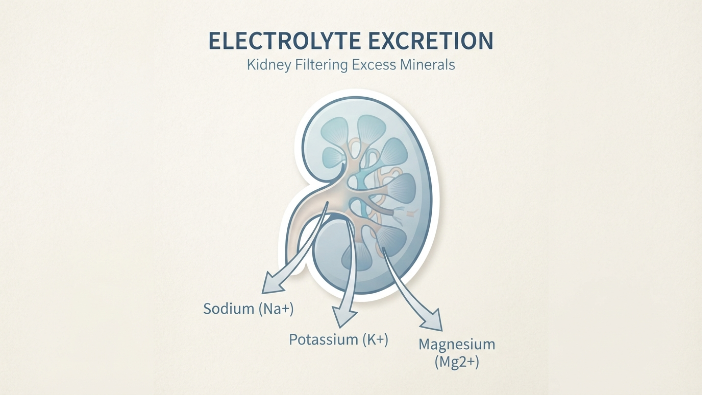
When you cut carbohydrates sharply, insulin levels drop, and that has a direct knock on effect on your kidneys. Lower insulin signals your kidneys to hold onto less sodium, so you excrete more of it, and water follows the sodium out.
Cleveland Clinic dietitian Beth Czerwony explains that cutting carbohydrates this way can lead to dehydration, which is part of why sugar free electrolyte drinks are commonly recommended in the first couple of weeks of keto.
That sodium and fluid loss does not happen in isolation. As your body flushes out water it tends to take other minerals along with it, and magnesium is one of the ones most likely to run low, alongside potassium.
This is the mechanism behind what most people call keto flu, and it is also, in my experience, one of the most overlooked explanations for disrupted sleep in the first few weeks.
The Magnesium Connection
Magnesium is involved in more than three hundred enzyme reactions in the body, according to the National Institutes of Health Office of Dietary Supplements, including ones that regulate muscle function, nerve signalling and blood sugar control.
It is not a sedative and it will not knock you out, but it plays a supporting role in the processes that let your nervous system properly wind down.
Here is an important distinction I think gets lost online: having low magnesium can plausibly make sleep worse, but that is not the same as saying magnesium supplements will fix sleep for everyone.
A recent systematic review found that low magnesium status was associated with reduced sleep quality across several observational studies, including delayed sleep onset, more daytime sleepiness and shorter sleep duration.
That is a real association. The trial evidence for supplementing your way out of it is smaller and more mixed.
What the Research on Magnesium for Sleep on Keto Diet Actually Shows
I want to be straightforward about this because a lot of keto and wellness content overstates it. The National Center for Complementary and Integrative Health reviewed the research on magnesium supplements for sleep disorders and found that while some studies suggested a positive effect on self reported sleep, sleep efficiency and sleep time, the studies were generally small and often low quality, and the authors called for larger, longer, well designed trials.
That said, newer research is more encouraging than it used to be. A 2025 randomised, placebo controlled trial gave 155 adults with self reported poor sleep either 250 mg of magnesium bisglycinate daily or a placebo for four weeks.
The magnesium group saw a significantly greater drop in insomnia severity scores than the placebo group, though the researchers described the effect size as modest, and people who started out with lower dietary magnesium intake seemed to benefit more.
Other small trials on different forms, including magnesium L threonate, have reported improvements in sleep quality and daytime function, though again, sample sizes remain small.
Not every study agrees. One randomised trial in women with PCOS found magnesium oxide made no measurable difference to sleep quality over ten weeks.
The honest summary is that magnesium appears genuinely relevant for people whose sleep problems are linked to low intake or status, and far less relevant if your sleep issues have another cause entirely, such as stress, screen use before bed, caffeine timing, or an underlying sleep disorder.
How Much Magnesium Adults Actually Need

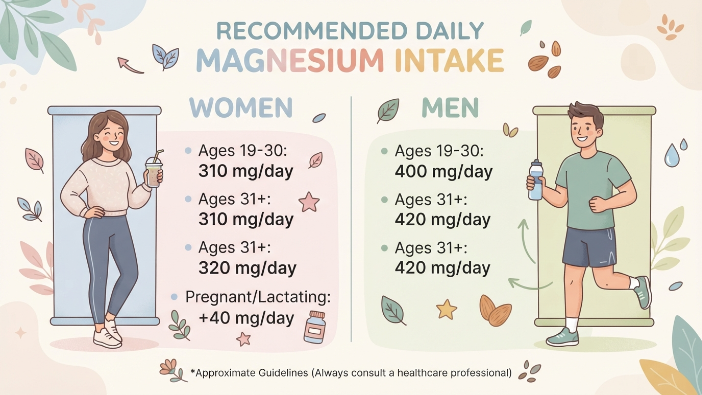
According to the NIH, the recommended daily amount for adult women is 310 to 320 mg, and for adult men it is 400 to 420 mg, with slightly higher needs during pregnancy. These figures include magnesium from all sources, food and supplements combined.
| Group | Recommended Daily Amount |
| Women, 19 to 30 | 310 mg |
| Women, 31 and older | 320 mg |
| Men, 19 to 30 | 400 mg |
| Men, 31 and older | 420 mg |
| Pregnant women | 350 to 360 mg |
The upper limit that applies specifically to supplements and medications, not food, is 350 mg per day for adults.
Anything above that should only happen under the guidance of a health professional, since high supplemental doses can cause diarrhoea, nausea and cramping, and in extreme cases, irregular heart rhythm.
Keto Friendly Magnesium Rich Foods
Good news here, because several of the best magnesium sources fit naturally into a keto plate.
| Food | Approximate Magnesium per Serving |
| Pumpkin seeds, 30 g | Around 150 mg |
| Almonds, 30 g | Around 80 mg |
| Spinach, cooked, 100 g | Around 87 mg |
| Avocado, one medium | Around 58 mg |
| Dark chocolate, 70 percent, 30 g | Around 65 mg |
| Chia seeds, 2 tbsp | Around 95 mg |
| Mackerel, 100 g | Around 76 mg |
A handful of pumpkin seeds and a serving of cooked spinach alone can get you a meaningful way toward your daily target, and if you already lean on our high fibre keto diet approach for digestion, you are likely eating several of these foods already.
Different Forms of Magnesium and What They Are Commonly Used For

Here’s something that trips people up constantly: magnesium isn’t just magnesium. The form on the label changes how well your body actually uses it, and honestly, most people never look past the front of the bottle.
The NIH points to citrate, lactate, aspartate and chloride as the ones that tend to absorb well, so those are a reasonable starting point if you’re comparing options.
Glycinate is the one you’ll see recommended most for sleep specifically, technically it’s bisglycinate, and it’s the exact form used in the trial I mentioned earlier. Part of why people like it is that it doesn’t tend to upset the stomach the way some other forms do.
Citrate absorbs well too, but push the dose up and it can loosen things considerably, which matters if constipation is already an issue for you on keto. Oxide is the one sitting cheapest on every pharmacy shelf, and there’s a reason for that.
It’s poorly absorbed, so it mostly just works as a laxative rather than doing much for sleep or muscle function, whatever the label might imply. Then there’s L threonate, a newer entry that’s been studied for actually crossing into brain tissue.
Early trials hint at benefits for sleep and cognition, but it’s still early days, so I wouldn’t build your whole strategy around it just yet.
When Supplementation May Make Sense
If your plate already looks like a proper whole food keto setup, think leafy greens, a handful of nuts most days, seeds, regular avocado, you might be closer to your target than you think without touching a supplement at all.
Where supplementing genuinely earns its place is in those first few weeks of adaptation, when fluid and mineral losses hit hardest, or if your diet is honestly a bit thin on magnesium rich food most days.
It’s also worth considering once you’ve actually ruled out other causes of poor sleep with a doctor, rather than reaching for magnesium as the first and only explanation.
Real World Scenarios About Magnesium for Sleep on Keto diet

A new keto beginner in week two. She is doing everything “right” on paper but is waking at 3am most nights. Her diet is heavy on cheese, bacon and cream, and light on vegetables and nuts.
Her pattern fits the classic early keto electrolyte dip described earlier, and improving food variety alongside sensible sodium and magnesium intake is a reasonable first step, alongside checking in with her GP if it does not improve within a couple of weeks.
Someone confusing electrolyte imbalance with a sleep disorder. He has been on keto for three months, still gets occasional muscle twitches at night, and assumes it must be magnesium.
It could be, but ongoing symptoms this far into fat adaptation are also a reasonable prompt to ask a doctor about other causes, since not every keto related symptom keeps a mineral explanation once the adaptation period has passed.
Someone taking magnesium for an unrelated reason. This one came up in the research almost by accident.
A woman starts magnesium glycinate because her period cramps are bad, not because she’s thinking about sleep at all, and a few weeks in she notices she’s actually staying asleep through the night.
That fits with what the observational studies keep finding, a link between magnesium status and sleep quality, even in people who weren’t chasing better sleep in the first place.
Signs That Should Not Simply Be Blamed on Magnesium
Not everything that happens at night on keto is a mineral problem, and I think it’s worth saying that plainly.
Loud snoring, gasping or choking sounds during sleep, chest pain, swelling in your legs that doesn’t go down, or sleep that was already bad before you ever cut a carb.
None of that has a magnesium explanation. If any of it sounds familiar, that’s a conversation for your doctor, not a reason to reach for another supplement.
Expert Tips About Magnesium for Sleep on Keto diet
Food first, always. Supplements are a top up, not the main event. In the first few weeks especially, salt your food properly rather than timidly, because sodium and magnesium tend to drop together, not separately.
If you do supplement, taking it in the evening is a sensible habit, mostly because that’s when you’d actually want any calming effect, though there’s nothing magic about the timing itself.
Check the label for elemental magnesium, not the total capsule weight, since those two numbers are often confusingly different.
Drink water, but don’t treat plain water as the whole solution when minerals are the actual gap. And honestly, if sleep is still off after a full month, that’s your cue to see a GP rather than quietly doubling your dose and hoping.
Common Mistakes
The big one I see constantly: assuming more magnesium equals better sleep. It doesn’t, past a certain point it just gives you an upset stomach.
Another is grabbing magnesium oxide off the shelf because it’s the cheapest bottle in the pharmacy, without knowing it’s one of the least absorbed forms going.
And then there’s the mistake of obsessing over magnesium while completely forgetting sodium and potassium, when in reality keto fatigue and poor sleep are almost always a multi mineral story, not a one ingredient fix.
An Evening Routine Worth Trying
Nothing complicated here. A dinner built around something magnesium rich, leafy greens, seeds, or a piece of fish.
Salt the meal properly instead of leaving it bland. Stop caffeine by early afternoon, not right before bed and not “just one more coffee at four.”
And give yourself a real wind down away from a screen. None of this is a guarantee, sleep rarely works that way, but it gives your body what it actually needs while also fixing the habits that get in the way regardless of what you eat.
Conclusion
Magnesium and sleep on keto is a real thing worth looking into, not a wellness myth and not some miracle fix either. The mechanism holds up: ketosis pushes more minerals out of your system, and magnesium supports the nervous system processes that let you actually wind down.
The supplement research is encouraging but still young, and it seems to matter most for people whose intake was genuinely low beforehand.
Start with your plate, be sensible if you add a supplement, and if sleep stays broken, that’s a signal to talk to someone, not something to white knuckle through alone with a bottle of tablets.
FAQs About Magnesium for Sleep on Keto diet
Can magnesium help with sleep on a keto diet?
For some people, yes, especially if their intake or status was low to start with. The research is still more limited and mixed than a lot of headlines suggest.
Why might I sleep worse after starting keto?
Usually it’s the mineral and fluid shift that happens once insulin drops in those first couple of weeks. Caffeine, stress, or just adjusting to an unfamiliar way of eating can all pile on top of that too.
What is the best magnesium for sleep on keto?
Magnesium glycinate tends to get recommended most often for sleep, partly because it’s easy on the stomach and partly because it’s the form used in a 2025 trial that showed a modest drop in insomnia severity scores.
How much magnesium do I need on keto?
Roughly 310 to 320 mg a day for adult women and 400 to 420 mg for adult men, counting food and supplements together, based on NIH figures.
Which keto foods are high in magnesium?
Pumpkin seeds, almonds, spinach, avocado, chia seeds, and mackerel all fit keto easily and genuinely move the needle on magnesium.
Should I take magnesium at night?
It’s a reasonable habit if you’re supplementing, mostly for convenience and any calming effect, but there’s no strict rule requiring it.
Can too much magnesium cause problems?
Yes. Go above the supplement upper limit of 350 mg a day and you’re looking at diarrhoea, nausea, and cramping, with very high intakes potentially affecting heart rhythm.
Can magnesium supplements interact with medications?
Yes, certain antibiotics, osteoporosis drugs, diuretics, and long term acid reflux medications among them, so run it past a pharmacist or doctor if you’re on regular medication.