
If you’ve gone months without a period, or you’ve stopped counting because the gaps are so unpredictable, you already know how isolating PCOS can feel. You’ve probably typed some version of “does period come back on keto PCOS” into Google late at night, hoping for a straight answer instead of another miracle-diet promise.
I’m not going to promise you that keto will bring your period back. What I can do is walk you through what the research on keto, PCOS, and menstrual cycles actually says, why irregular periods happen in the first place, and what a realistic, evidence-based approach looks like — including when keto isn’t the right tool at all.
Medical Disclaimer: This article is for educational purposes only and is not a substitute for advice from your GP, gynaecologist, or a registered dietitian. If you have missed periods, please don’t self-diagnose — pregnancy, thyroid issues, and other conditions can also cause missed cycles, and they need to be ruled out by a professional.
Does Your Period Come Back on Keto With PCOS?
For some women, yes — a ketogenic diet has been associated with a return of regular periods in PCOS, and the mechanism behind it is well understood: less dietary carbohydrate generally means lower circulating insulin, and insulin is one of the main drivers of the hormonal imbalance behind PCOS-related cycle disruption.
That said, “does period come back on keto PCOS” doesn’t have one universal answer, because PCOS itself isn’t one single condition. Two women can carry the same diagnosis and have very different underlying drivers — insulin resistance, high androgens, adrenal factors, or a combination.
Keto tends to help most when insulin resistance is the main engine behind your symptoms. When it isn’t, cutting carbohydrates alone may do much less.
Worth Remembering: A returning period is a meaningful sign that ovulation may be happening again, but it isn’t proof of anything permanent. Cycles can still be irregular even after some improvement, and stopping keto typically allows insulin levels — and the symptoms tied to them — to drift back.
Why PCOS Can Cause Irregular or Missing Periods
Quick version of what’s going on under the hood: in a typical cycle, your brain sends out hormonal signals telling your ovaries to mature and release an egg.
Ovulation happens, progesterone kicks in, the uterine lining thickens up in preparation — and if pregnancy doesn’t happen, that lining sheds. That’s your period, working as intended.
PCOS derails that process, and insulin is usually where it starts. Most women with PCOS deal with some level of insulin resistance — their cells just don’t respond to insulin properly, so the pancreas keeps producing more of it to try to keep up.
That excess insulin then pushes the ovaries into overproducing androgens, testosterone being the one most people recognise, and androgens interfere with an egg maturing and releasing the way it should.
No ovulation, no real progesterone rise — and that’s when cycles start drifting: getting longer, becoming unpredictable, sometimes stopping for months at a stretch. The medical terms are oligomenorrhea for infrequent periods and amenorrhea once they’ve been absent long enough.
And it’s rarely just one thing. Genetics, low-grade inflammation, extra body weight — they all tend to feed into the same loop, which is part of why “cut the sugar and you’ll be fine” was never realistic advice for most women with this condition.
How Keto May Affect PCOS and Menstrual Cycles
A ketogenic diet — very low carb, higher fat, usually somewhere around 20 to 50 grams of carbs a day — asks a lot less of your pancreas after meals. For someone whose PCOS is driven mainly by insulin resistance, that alone can meaningfully lower how much insulin is circulating.
The theory goes like this: less insulin means less of a push toward androgen overproduction, and lower androgens create a hormonal environment where a follicle can actually mature and ovulation can happen again — which is really the step that gets a period back.
If you want the fuller picture on hormones beyond just the cycle itself, that’s covered in our piece on whether keto can reverse PCOS symptoms more broadly.
Author Note: What stood out to me while going through the research wasn’t the weight-loss angle — plenty of diets do that. It was that several studies picked up menstrual improvements tracking alongside falling insulin and androgen levels, and in some cases, before any real weight had come off.
What Does the Research Actually Say About Keto, PCOS, and Periods?

I want to be careful here, because it’s easy to swing too far in either direction — overselling this or dismissing it outright.
Start with a retrospective study out of the Cleveland Clinic: 30 women with PCOS followed a ketogenic diet for at least three months, and every single one of them had their cycles come back to regular. Among those who were trying to conceive, 55.6% got pregnant during the study window
Then there’s a pilot study from Sapienza University in Rome — 18 women, 45 days on keto, followed by a gradual reintroduction of carbs. Twelve made it to the six-month follow-up, and the researchers found real, statistically significant improvement in cycle frequency, ovarian volume, and reproductive hormones — and it happened regardless of how much weight anyone lost
An older case series told a similar story: a handful of women with obesity and PCOS got regular cycles back on a very-low-carb diet, sometimes within a month, even with only modest weight loss. That timing is part of why researchers suspect it’s the drop in insulin doing the work, not the weight loss itself.
My Takeaway: This is encouraging, genuinely. But I’d be doing you a disservice if I didn’t point out that these are small studies, run over a matter of months, not years — not big randomised trials. Call it promising early evidence. Don’t call it proof it’ll work for you specifically.
How Long Could It Take to Notice Changes?
Going by what’s in the studies, most women who saw changes noticed them somewhere between six weeks and three months in, with three months being where the strongest results showed up.
A few in the case reports noticed something shifting within weeks; others took considerably longer, especially if there was more weight to lose or insulin resistance was more entrenched.
And if nothing’s changed after a few months of doing this properly — well-formulated, actually getting enough nutrients — that tells you something too. It might mean insulin resistance isn’t really what’s driving your PCOS, or that diet alone isn’t going to be enough on its own.
Why Keto May Not Restore Periods for Everyone With PCOS
PCOS is not a single condition with a single fix, and it’s important not to imply otherwise.
PCOS isn’t one condition with one fix, and I don’t want to pretend otherwise.
- Lean or adrenal-type PCOS — if insulin resistance isn’t really your issue (more common with lean PCOS), cutting carbs doesn’t have much to work with, so don’t expect the same results. We go deeper into that distinction in our insulin-resistant vs. lean PCOS comparison.
- Not eating enough — a badly planned very-low-carb diet can leave you under-fuelled, and being in a chronic energy deficit can shut down menstrual function on its own — which is the exact opposite of what you’re going for.
- Stress and poor sleep — cortisol messes with the same hormonal pathways keto is trying to fix.
- Something else entirely — thyroid issues, high prolactin, other endocrine conditions can all cause missed periods, and none of them care how many carbs you’re eating.
- Just needing more time — some women need longer than a few months, or need keto paired with something like metformin or inositol, which is a conversation for your doctor, not a diet blog.
Other Factors That Can Affect Your Menstrual Cycle
Worth saying plainly: your cycle responds to a lot more than food. Stress, bad sleep, overtraining, losing weight too fast, certain medications, your thyroid — and obviously, pregnancy — can all throw things off.
If there’s any chance you could be pregnant, take a test before chalking a missed period up to “just PCOS.” Getting your period back on keto isn’t usually about carbs in isolation — it’s typically several things working together, which is exactly why the expert tips section below covers more than just what’s on your plate.
Real-Life Experiences: What Women With PCOS Have Reported

I want to be transparent about what this section is and isn’t. These are not controlled studies, and one person’s outcome doesn’t predict yours. I’m including them because they illustrate the range of real experiences people describe — some encouraging, some more mixed.
Published account — Carolina’s story (Diet Doctor): Carolina was diagnosed with PCOS at 13 and had never had a natural menstrual cycle. After years of unsuccessful diet attempts, she began a ketogenic diet in 2014.
According to her published account, she experienced her first natural cycle roughly four months after starting keto, alongside substantial weight loss over the following years. This is a single, self-reported story published as a first-person account, not a clinical study — read the original here: Diet Doctor – Carolina’s story.
Anecdotal forum discussion (HealthUnlocked / PCOS UK – Verity): In a public PCOS support forum thread, one contributor described using a low-carbohydrate, high-fat diet alongside cycle tracking and reported that her cycles became regular and that she began ovulating predictably.
Another contributor in the same thread described a comparable experience while trying to conceive. These are anonymous, unverified forum posts, not medical evidence, but they reflect the kinds of experiences people commonly share: HealthUnlocked – PCOS UK (Verity) thread.
Author Note: Not every account online is this positive. In the same online communities, plenty of women with PCOS report trying keto with little or no change to their cycle — often because their PCOS wasn’t primarily insulin-driven, or because other health factors were also at play. I’d rather show you that range than cherry-pick only the success stories.
Expert Tips for Supporting Menstrual Health With PCOS
Ask five dietitians who specialise in PCOS whether keto is “the” answer and you’ll get five slightly different opinions. But most of them land on the same handful of principles underneath.
Stony Brook Medicine’s PCOS Center
Stony Brook Medicine’s PCOS Center is a good example. Their team has said low-carb or ketogenic eating can help some women with PCOS by improving insulin sensitivity — but they’re clear it’s not something everyone needs, or can stick with, and that a more moderate approach built around fibre, lean protein, and healthy fats tends to hold up better over the long run (Stony Brook Medicine, Nutrition Management for PCOS).
Which is a fair point, honestly — “low-carb” and “strict keto” aren’t the same thing, and you don’t have to go all the way to the extreme to get real benefits.
So with that in mind, here’s what tends to actually matter for cycle regularity:
- Don’t under-eat. This trips people up more than they expect. Going too low on calories can suppress ovulation on its own, so if you’re doing keto, make sure it’s actually feeding you — not just low-carb in name.
- Protein and fibre first. They keep blood sugar steadier and keep you fuller, and fibre especially is the first thing to quietly disappear from a badly put-together keto diet.
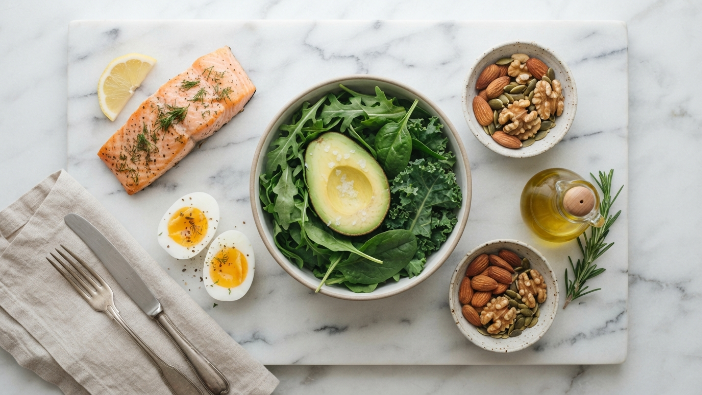
- Fat quality matters. Olive oil, oily fish, nuts, avocado — these do more for your hormones than leaning on processed fats because “it’s keto so it’s fine.”
- Move, but don’t overdo it. Regular movement helps insulin sensitivity. Grinding through intense training every day adds a different kind of stress that can work against you.
- Sleep and stress aren’t optional extras. Cortisol and insulin talk to each other. Skimp on sleep or stay chronically stressed and you can undercut everything else you’re doing with food.
- Watch your cycle, not just the scale. A regular period tells you more about what’s actually improving hormonally than your weight does.
- Get monitored. If you’re on medication such as metformin, or you’re trying to conceive, loop your GP or endocrinologist in before making major dietary changes, so they can adjust your care plan accordingly.
Our guide on protein intake for women with PCOS and our breakdown of why PCOS weight loss stalls even when you’re “doing everything right” both go deeper into the practical side of this.
When You Should Talk to a Doctor

Please see a doctor if:
- You’ve missed a period and there’s any possibility of pregnancy
- You’ve had no period for three months or more and you’re not on hormonal contraception
- Your periods stop altogether after previously being regular
- You experience very heavy, prolonged, or painful bleeding
- You’re trying to conceive and haven’t had guidance on your specific PCOS phenotype
- You have a history of disordered eating and are considering a restrictive diet like keto
A doctor or gynaecologist can check for other causes of missing periods, discuss whether medication such as metformin or inositol is appropriate alongside dietary changes, and help you build a plan that’s realistic for your specific presentation of PCOS — something no article, including this one, can safely do for you.
Conclusion
So, does period come back on keto PCOS? For a meaningful number of women — particularly those whose PCOS is driven mainly by insulin resistance — the evidence suggests it can, and the studies we’ve walked through here describe real, measurable improvements in menstrual regularity alongside falling insulin and androgen levels.
But PCOS is genuinely different from person to person, and keto is not a guarantee, a cure, or the only path forward.
If you decide to try it, give it a fair, well-planned trial of a few months, pair it with adequate sleep, manageable stress, and enough calories and nutrients to support your hormones rather than fight them — and keep your GP or a registered dietitian in the loop, especially if you’re trying to conceive or managing other health conditions.
My takeaway from researching this topic is a simple one: keto is a legitimate, evidence-supported option worth discussing with your doctor if insulin resistance looks like your main driver — not a promise, and not the only option on the table.
Frequently Asked Questions
Does period come back on keto PCOS? For some women, yes — several small studies and published accounts describe menstrual cycles returning after a period of low-carbohydrate or ketogenic eating, likely linked to lower insulin and androgen levels. It isn’t guaranteed, and results vary depending on what’s driving your PCOS.
Can keto regulate periods with PCOS? Keto may help regulate periods in PCOS driven primarily by insulin resistance, by lowering insulin and reducing excess androgen production. It’s less likely to help regulate periods where lean PCOS, adrenal factors, or other hormonal conditions are the main driver.
How long does it take for periods to become regular on keto? In the available research, most reported improvements occurred between six weeks and three months of consistent low-carbohydrate eating. Individual timelines vary considerably, and some women need longer or additional support.
Can keto help with PCOS-related irregular periods? It can for some women, primarily by improving insulin sensitivity and lowering androgen levels, both of which support more regular ovulation. It works alongside, not instead of, other lifestyle factors like sleep, stress, and adequate nutrition.
What happens if my period does not return on keto? It doesn’t necessarily mean you’re doing something wrong. It may mean insulin resistance isn’t your main driver, that more time or medical support is needed, or that another cause of missing periods should be investigated with your doctor.
Can weight loss improve periods with PCOS? Weight loss of even 5–10% of body weight has been associated with improved menstrual regularity in PCOS in various studies, though some research suggests menstrual improvements on keto can occur even before significant weight loss, likely due to falling insulin levels.
Is keto safe for women with PCOS? It can be, when it’s well-planned and nutritionally adequate, but it isn’t automatically the right choice for everyone with PCOS — particularly those with a history of disordered eating, thyroid conditions, or lean PCOS. Speak with a doctor or dietitian before starting.
Can you ovulate even if your periods are irregular with PCOS? It’s possible but less predictable. Irregular periods in PCOS usually reflect irregular or absent ovulation, which is why cycle tracking alone isn’t a reliable form of contraception or conception planning without professional guidance.
When should you see a doctor about missing periods? See a doctor if you’ve missed three or more periods in a row (and aren’t on contraception that suppresses them), if pregnancy is possible, or if your cycle changes suddenly and significantly. Persistent amenorrhea should always be medically evaluated.