You used to fall asleep the second your head hit the pillow. Now it’s 3am and you’re just lying there, sheets damp, heart doing something it really shouldn’t be doing at this hour, wondering when your own body turned into a stranger.
Maybe it’s the sugar cravings ambushing you at 4pm out of nowhere. Or maybe it’s simpler than that, whatever kept you steady for years just quietly stopped working sometime in your early forties, and nobody bothered to warn you it would.
If any of this sounds familiar, you’re probably in perimenopause. And you probably landed on this because you typed some version of “Keto Diet for Perimenopause Symptoms” into Google at midnight, hoping for something more useful than another influencer promising a miracle in a jar.
Fair enough. When your body starts acting like it doesn’t belong to you anymore, you want something, anything, that hands back a bit of control. So here’s the honest version.
I’m going to walk through what’s actually happening hormonally during perimenopause, which symptoms keto might genuinely help with, where the research falls short, and how to try a ketogenic approach without turning it into one more thing stressing out a body that’s already dealing with enough.
What’s actually happening to your body during perimenopause
Perimenopause is the stretch of years before your final period, and it can run anywhere from a couple of years to nearly a decade. Oestrogen and progesterone don’t decline in some tidy, predictable slope during this time. They swing, sometimes wildly, and those swings show up almost everywhere in the body.
Oestrogen isn’t just about your cycle, even though that’s mostly how we’re taught to think about it. It affects how your cells respond to insulin, where your body decides to store fat, how your brain handles temperature and mood, even how well you actually sleep at night.
So once oestrogen and progesterone start swinging around unpredictably, a handful of things tend to follow. Insulin sensitivity often drops. Ghrelin, your hunger hormone, tends to climb. And fat starts settling around your middle even when nothing about your eating or your activity has actually changed.
None of that means your body is broken. It means the metabolic terrain you’re standing on has genuinely shifted from where it was in your twenties and thirties, and some of the old strategies just don’t map onto it anymore.
The symptoms most women actually deal with
Every woman goes through this a bit differently, but the usual suspects show up again and again. Hot flashes and night sweats. Sleep that’s thinner or more broken than it used to be. Weight gain that seems to land specifically around the middle.
Carb cravings that feel stronger than before. Brain fog. Mood swings, or just a low mood that lingers. Fatigue that comes and goes without warning. Irregular periods. Achy joints. A lower sex drive.
There’s an Irish study looking at how much this stuff actually disrupts daily life, and it found that roughly four out of five women in this stage said the symptoms were genuinely getting in the way, not some minor thing they could just push through.
That number alone probably explains why so many women end up down a Google rabbit hole looking for a dietary fix.
Can keto actually help with perimenopause symptoms?
Honestly? Keto can help with some of it, mainly the pieces tied to blood sugar and insulin. What it isn’t is a treatment for perimenopause itself, and it won’t correct hormonal decline directly.
What keto does change is how your body sources fuel. Cut carbs down hard, usually under 50 grams a day, and your body switches over from running mostly on glucose to running on fat and ketones instead.
That switch lowers the insulin circulating in your system and can improve how sensitive your cells are to it, which matters a lot here, since declining oestrogen is already dragging insulin sensitivity down on its own.
Something worth flagging: most of the research linking keto to perimenopause relief is indirect. It’s studies on insulin resistance and menopause, or on low carb diets and weight, not keto specifically, and a lot of it leans on self reported outcomes rather than controlled trials.
That doesn’t make it useless. It just means the picture is encouraging in places and genuinely fuzzy in others, and I’d rather say that outright than dress it up.
Which symptoms might actually improve

The symptoms most plausibly connected to insulin and blood sugar are the ones keto has the best shot at helping.
Weight Gain
The middle-of-the-body weight gain is probably the most common complaint at this stage. A large observational study of close to 89,000 postmenopausal women found that those eating fewer carbohydrates had a lower risk of weight gain compared to other diet patterns, though the carb ceiling in that study was well above what a true ketogenic diet allows.
So it suggests cutting carbs generally may help with weight around menopause, not that strict keto necessarily beats a more moderate low carb approach. Here’s something that gets glossed over a lot. Weight gain during perimenopause isn’t just a calories in, calories out equation, no matter how many times that gets repeated.
Hormones change where fat actually lands on your body and how hungry you feel throughout the day, which is a big part of why some women do better focusing on protein, healthy fats, and steadier blood sugar rather than obsessing over calorie counts. Also read “PCOS Weight Loss: Why It’s So Hard (And How I Lost 40kg)”
Blood sugar and insulin resistance
This is where the evidence holds up best. Insulin resistance reliably increases through the menopause transition as oestrogen falls. Since a ketogenic diet takes a lot of the carbohydrate load off your system, it tends to bring circulating insulin down and improve insulin sensitivity, something backed up across several reviews on ketogenic diets and metabolic health.
Ghrelin climbs during perimenopause too, and that’s a big reason cravings can feel harder to ignore than they used to be, almost like they’ve got more teeth. Keeping blood sugar steadier through a lower carb approach can take the edge off some of those spikes and crashes that usually set cravings off in the first place.
That said, sleep, stress, and mood all feed into cravings as well, and all three tend to be a bit shaky at this stage of life, so keto on its own probably isn’t going to make cravings disappear completely. It might just make them more manageable. Also read Keto Diet Insulin-Resistant PCOS vs Lean PCOS: Top Practical, Evidence-Based Guide
Keto and Energy Levels
Some women do report steadier energy once they’re fully adapted to ketosis, since ketones tend to give a more even fuel supply than glucose, which spikes and crashes throughout the day.
Worth flagging though, the adjustment period, sometimes called keto flu, can actually make fatigue worse for a while, and that overlaps in an annoying way with the fatigue a lot of women are already dealing with during perimenopause anyway. Going in slowly, with adequate electrolytes, makes a real difference.
Keto and Sleep or Night Sweats
This is one of the more debated areas. A few women describe fewer or milder night sweats once they’ve settled into ketosis, and the theory is it might come down to better insulin regulation, since insulin resistance has been linked in some research to a higher chance of vasomotor symptoms like hot flashes.
But formal clinical trials actually testing keto specifically against hot flashes are pretty thin on the ground, and plenty of other women report no real change, or find that the early keto adjustment period messes with their sleep before things settle down.
Keto and Brain Fog or Mood Changes

Brain fog during perimenopause is a real, well documented phenomenon linked mainly to fluctuating oestrogen’s effect on memory and processing speed.
Ketones can serve as an alternative brain fuel, and some small studies suggest ketogenic approaches may support aspects of cognitive function such as attention and memory.
My biggest takeaway from the available evidence is that this is encouraging but preliminary, particularly for perimenopause specifically rather than cognition in general.
What Does the Scientific Evidence Actually Say?
I want to be direct about where the research stands, because a lot of content in this space overstates it.
What’s reasonably well supported:
- Ketogenic and low carbohydrate diets can improve insulin sensitivity and lower fasting insulin, an effect confirmed across several reviews of metabolic health research.
- Insulin resistance rises measurably during the menopause transition as oestrogen declines.
- A large cohort study found a link between lower carbohydrate intake and reduced postmenopausal weight gain, though not using a strict keto framework.
What’s still genuinely up in the air. Whether keto specifically, as opposed to a more moderate low carb or Mediterranean style approach, actually beats other options for perimenopause symptoms.
Whether keto does anything measurable to oestrogen or progesterone levels themselves, there’s just no solid evidence pointing either way right now. And whether keto reliably cuts down hot flashes across women generally, versus what shows up in scattered personal accounts.
What keto isn’t going to do. It won’t replace hormone therapy in cases where that’s clinically the right call. It won’t reverse the hormonal transition itself. And it shouldn’t be sold or understood as some kind of hormone balancing protocol, because that’s not what the evidence supports.
The picture is encouraging in a few areas but still thin in a lot of the places women care about most, and right now the research just doesn’t back up the idea that keto directly treats things like hot flashes or mood swings the way an actual targeted medical treatment would.
Real Life Experiences With Keto and Perimenopause
I want to be transparent about something important: genuinely verifiable, individually attributed accounts specifically about perimenopause and keto are harder to find than you might expect, since most published material blends menopause and perimenopause together, and much of what circulates online is anonymous or unverifiable.
One account I can point to comes from Diet Doctor’s public reader Q&A archive, where a 50 year old woman, writing under the name Samantha, described having maintained a stable, healthy weight on a low carb diet for five years before menopause.
After roughly a year without a period, she found that even nine weeks of strict, well formulated keto led to continued weight gain rather than the results she’d previously seen, despite consistent exercise, portion control, and normal thyroid and glucose bloodwork.
In his published response, Dr. Andreas Eenfeldt, the physician who founded Diet Doctor, acknowledged that menopausal weight gain is extremely common even among women eating well, and suggested that adding structured intermittent fasting is often what helps in cases like hers, rather than restricting food further.
What you can reasonably take from this: keto is not a guarantee, and it does not automatically override the metabolic changes that come with this life stage, even for someone already experienced with low carb eating.
What you cannot take from it: one woman’s outcome does not tell us what will happen for you, and it isn’t scientific proof of anything beyond her own physiology and circumstances. I’d treat this as a useful, honest data point rather than a verdict.
Expert Tips for Using Keto During Perimenopause

Liz Weinandy, RD, lead outpatient registered dietitian at Ohio State University Wexner Medical Center, has cautioned publicly that classic and modified keto diets are considerably more restrictive than typical eating patterns, since they push carbohydrate intake down to roughly 10 percent of calories and eliminate entire food groups, which can make the diet genuinely difficult to sustain long term.
Her broader point, discussed in coverage from US News, is that sustainability matters as much as short term results, particularly for a life stage that already asks a lot of a woman’s body.
Dr. Anna Cabeca, a board certified OB/GYN who works in integrative medicine and specialises in menopause and women’s hormonal health, has written a fair amount about pairing lower carb eating with a strong focus on non starchy vegetables during perimenopause, partly as a way to soften some of the more restrictive edges of very strict keto.
Her main recommendation, which she’s published on her own site, is built around improving insulin sensitivity through cutting carbs while still making sure there’s enough plant food coming in, rather than defaulting to the heavier, meat and dairy heavy version of keto that tends to dominate online.
Why this matters for someone in perimenopause: both of these perspectives point toward the same underlying principle, that a well formulated, nutrient dense lower carbohydrate approach is likely to serve you better during this transition than an extremely restrictive or poorly planned version of keto.
How to Start Keto During Perimenopause Safely

If you’re going to try this, easing in tends to work better than diving straight into full restriction. Cut carbs down gradually over a week or two instead of jumping from a higher carb pattern straight to under 20 grams a day.
Make protein a priority, since holding onto muscle mass matters more, not less, at this stage of life. Load up on electrolytes early, sodium especially, along with magnesium and potassium, to keep keto flu from hitting as hard.
Pay attention to how you actually feel, not just what the scale says, since sleep, mood, and energy tell you just as much about whether this is working for you. And give it at least four to six weeks before deciding either way, because the adjustment period can hide the benefits at first.
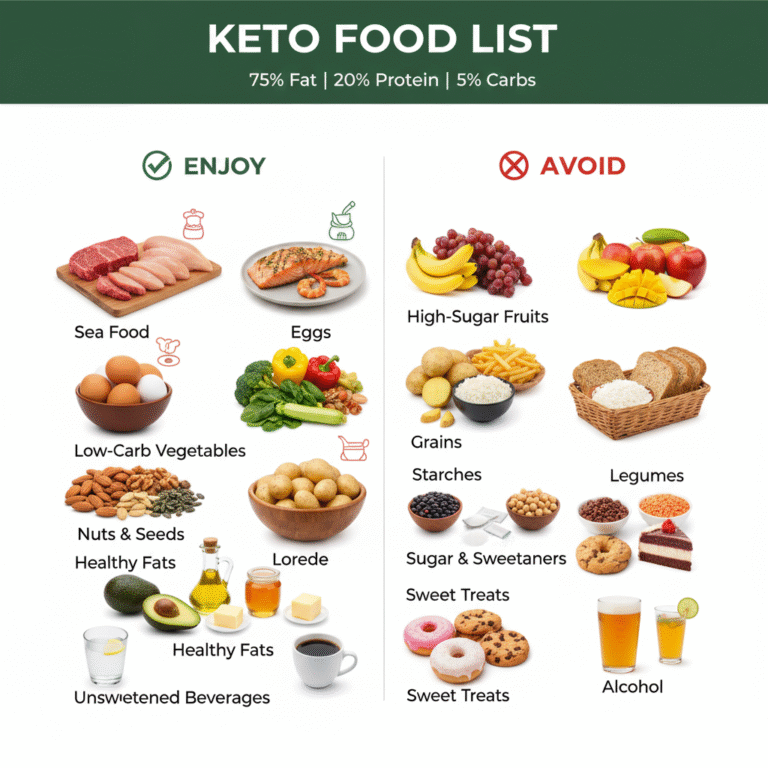
Foods to Prioritise
Worth prioritising on the plate:
- fatty fish like salmon and mackerel for the omega 3s and protein.
- Avocados, olive oil, and nuts for healthy fats and a bit of fibre.
- Leafy greens and cruciferous vegetables for fibre and micronutrients.
- Eggs, along with grass fed or pasture raised meat, for protein and B vitamins.
- Full fat dairy or dairy alternatives, depending on tolerance
- Chia seeds and flaxseed for additional fibre and plant compounds
- Bone broth and mineral rich foods to support electrolyte balance
Common Mistakes Women Make When Trying Keto During Perimenopause
And the mistakes that tend to come up again and again.
- Cutting carbs too hard, too fast, which can spike cortisol and actually make sleep and mood worse in the short run.
- Not eating enough protein, which speeds up muscle loss at a point in life when holding onto muscle is already an uphill climb.
- Ignoring electrolytes entirely and just chalking the resulting fatigue up to getting older, when really it’s a fixable side effect of the diet.
- And leaning too hard on processed meats and lower quality fats, which can push LDL cholesterol up, something that matters more once cardiovascular risk starts climbing after menopause anyway.
- Expecting keto to resolve every symptom, then abandoning it entirely when hormonal symptoms persist regardless
When keto might not be the right call
Keto isn’t automatically the right move for every woman going through perimenopause. If you’ve got diabetes, you’re on anything that affects blood glucose, you’re dealing with kidney disease, you’ve had gallbladder issues, there’s a history of disordered eating, or you’re already juggling a thyroid problem alongside perimenopausal symptoms, talk to your GP or a registered dietitian before you start anything.
It’s also worth keeping an eye on cholesterol through bloodwork while you’re at it. Low carb diets can push LDL up in some people, and that matters more now that the cardiovascular protection oestrogen used to provide is starting to fade.
When it’s time to talk to someone
If your symptoms are really getting in the way of your life, think persistent low mood, sleep that’s falling apart, hot flashes disrupting your day, then it’s worth sitting down with your GP or a menopause specialist and talking through actual medical options, hormone therapy included where it makes sense, instead of leaning on diet alone to carry the whole load. Diet can genuinely help. It just isn’t a stand in for medical care once things get severe.
Where this leaves you
I wouldn’t treat keto like a fix for perimenopause, because it’s not one. I would treat it like one useful tool among several, especially if blood sugar swings, cravings, and stubborn weight gain are what’s bothering you most. Hot flashes, mood, and sleep are a different story, and they’ll probably need more than a change in diet to sort out.
Questions people actually ask
Can keto help with perimenopause symptoms?
It can help with some of it, things like cravings, steadier energy, and weight, since those tie back to blood sugar and insulin. The evidence for keto doing much for hot flashes, mood, or sleep is thinner and honestly a bit mixed.
Is keto safe during perimenopause?
For most healthy women, yes, as long as it’s done properly with enough protein, fibre, and electrolytes. If you’ve got certain health conditions, check with someone qualified before jumping in.
Can keto reduce perimenopause weight gain?
It might, mostly by lowering insulin and dialling down cravings. Some large studies do link eating fewer carbs to less postmenopausal weight gain, but results vary a lot person to person, and keto won’t guarantee anything here.
Can keto help with hot flashes?
Several women say their hot flashes get milder, possibly because of better insulin sensitivity, but there’s no solid clinical trial data testing keto against hot flashes directly. So it’s promising, not proven.
Does keto affect oestrogen?
Not that the evidence shows clearly, one way or the other. What keto is better established for is insulin and blood sugar, not reproductive hormones themselves.
Can keto help with cravings during perimenopause?
Often, yes, mainly by keeping blood sugar from swinging as hard, which is usually what sets cravings off. Sleep and stress matter here too though, so it’s not the whole story.
What should a woman eat on keto during perimenopause?
Protein at every meal, healthy fats like olive oil and avocado, plenty of non starchy vegetables for fibre, and real attention paid to sodium, magnesium, and potassium.
Can keto help with blood sugar during perimenopause?
This is probably the strongest benefit on the list. Cutting carbs lowers the glucose and insulin load your body has to deal with, which matters more as insulin sensitivity naturally drops during this stage.
Why am I not losing weight on keto during perimenopause?
Hormones can slow weight loss down and make it unpredictable no matter how well you’re eating. Bad sleep, high stress, not enough protein, or hidden carbs in packaged keto products can all quietly stall things too.